EquiGQNet: Fast Grasp Quality Evaluation
via Shared Equivariant Point Cloud Encoding
Abstract
Planning six-degree-of-freedom (6-DoF) grasps for unseen objects in cluttered tabletop scenes from a single-view depth image requires accurate and efficient evaluation of diverse grasp candidates. Existing early-fusion methods capture local object geometry relative to each grasp candidate but repeatedly encode the scene, whereas late-fusion methods reuse a shared scene representation but may lose this grasp-relative local geometry. We propose EquiGQNet, an efficient 6-DoF grasp quality evaluator that combines the strengths of both approaches. For grasp orientation, EquiGQNet replaces the early-fusion operation of rotating and re-encoding the point cloud for each grasp candidate with an SO(3)-equivariant encode-once-then-rotate scheme, yielding grasp-aligned geometric features from a shared scene encoding. For grasp translation, Mid-level Action Fusion (MAF) injects the grasp position into intermediate features before global aggregation, retaining local geometry relative to each candidate. We evaluate EquiGQNet in two grasp planning pipelines: Cross-Entropy Method (CEM)-based continuous grasp search and candidate ranking with a pretrained generative planner. In simulation, EquiGQNet achieves grasping performance comparable to the early-fusion baseline and substantially outperforms late fusion on objects with complex geometry and limited graspable regions, while reducing CEM planning time from 3.31 s to 0.48 s, a 6.9× speedup over early fusion. In real-world household-object decluttering, EquiGQNet achieves a 95.2% grasp success rate and 230 picks per hour, versus 153 and 170 for early- and late-fusion baselines.
Introduction
Summary of EquiGQNet
Reliable robotic grasping of unseen objects requires selecting an appropriate six-degree-of-freedom (6-DoF) grasp pose from limited observations. For objects with complex geometry, successful grasps may occupy only narrow regions of the 6-DoF grasp space, making it important to explore diverse grasp candidates and evaluate them accurately. Among methods that directly evaluate arbitrary 6-DoF grasp poses, late-fusion methods reuse a shared scene representation but may not explicitly capture local geometry relative to the gripper, whereas early-fusion methods introduce the grasp pose before encoding and therefore capture grasp-relative geometry, but require reconstructing the input and running the entire encoder for every new candidate. We therefore seek a grasp evaluator that can accept arbitrary 6-DoF poses, exploit geometric information specific to each grasp as in early fusion, and still reuse a single point cloud encoding across many candidates.
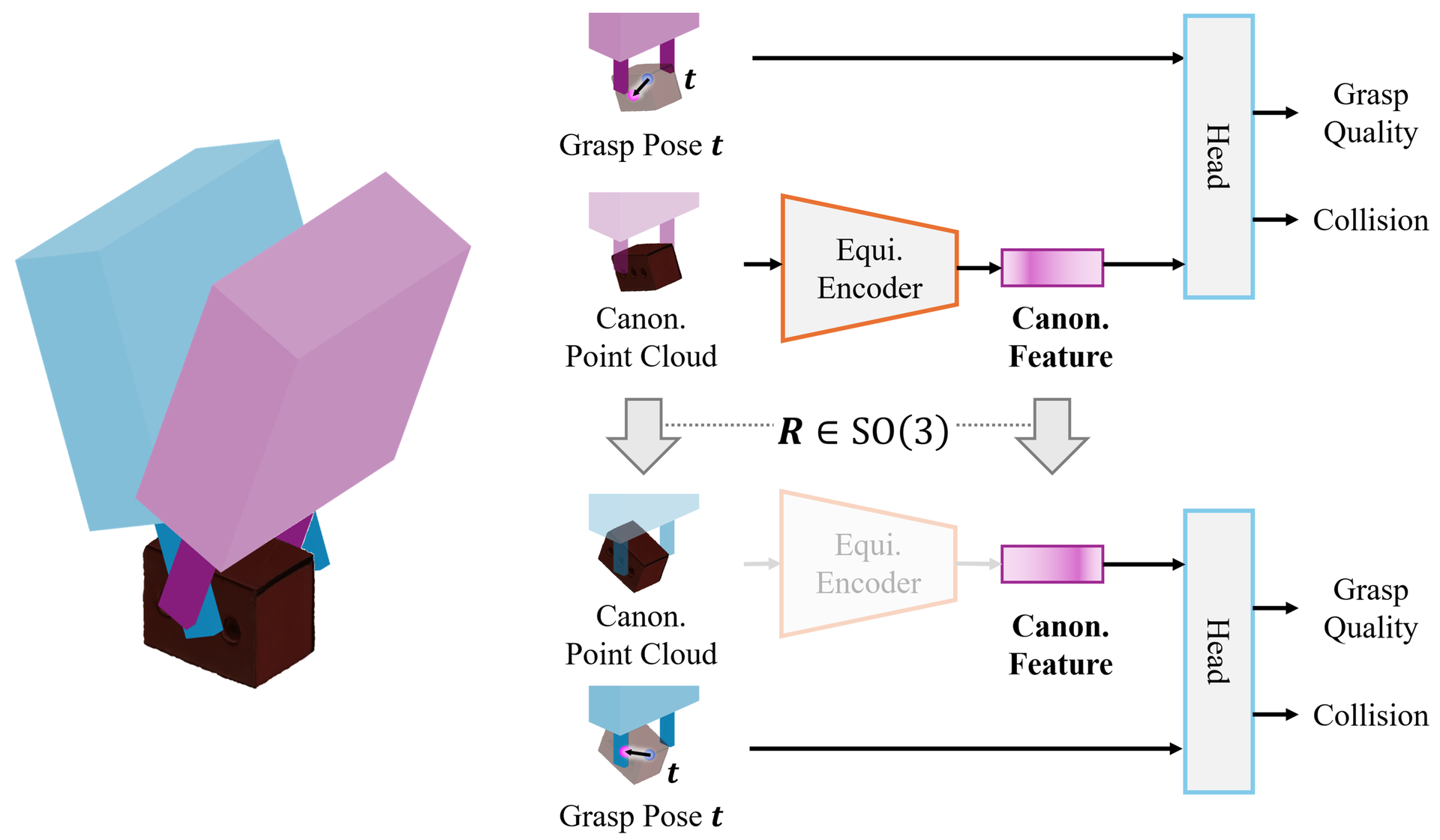
We propose EquiGQNet, a 6-DoF grasp evaluation model that captures object geometry relative to each candidate grasp while reusing a single point cloud encoding across candidates. As illustrated above, EquiGQNet handles grasp rotation and translation differently. For rotation, EquiGQNet retains the early-fusion treatment of grasp orientation by rotating the point cloud according to each candidate grasp orientation before encoding. SO(3) equivariance allows the same grasp-oriented features to be obtained by rotating a single shared encoding, avoiding candidate-wise re-encoding.
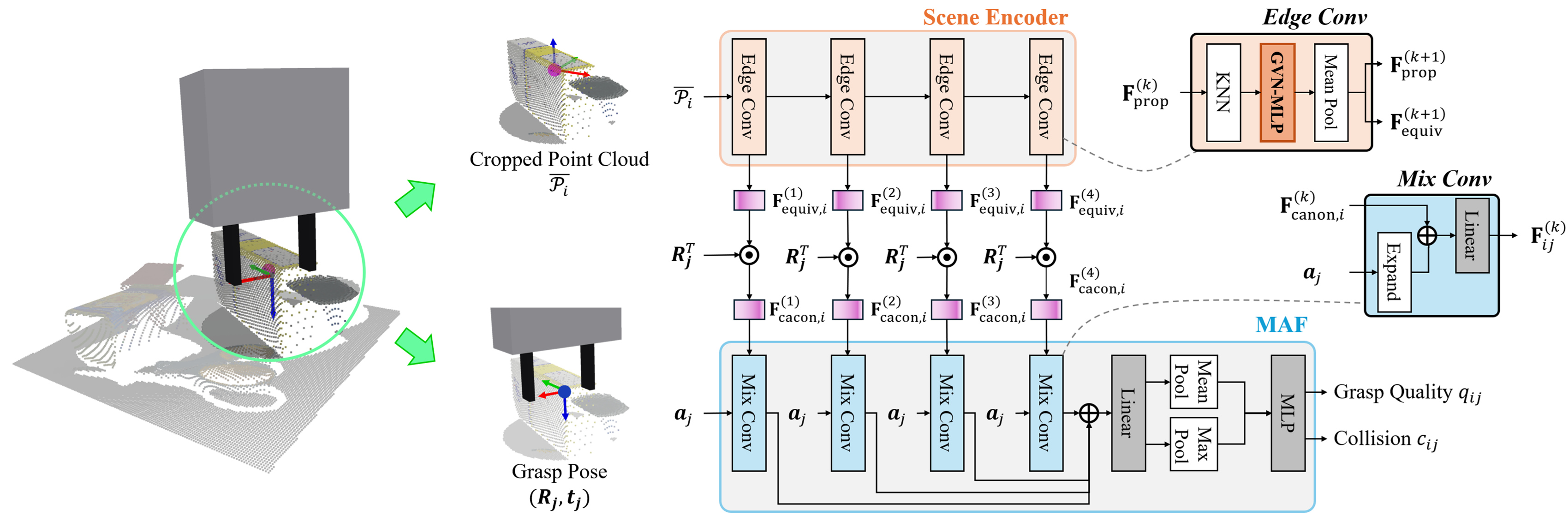
For translation, Mid-level Action Fusion (MAF) incorporates the grasp position at intermediate feature layers before local geometric information is lost through global aggregation. As shown in the architecture, EquiGQNet encodes a local point-cloud crop once into shared SO(3)-equivariant features; for each grasp candidate, these features are rotated according to its orientation and fused with its position through MAF before global aggregation. Together, these designs allow EquiGQNet to evaluate each grasp using object geometry relative to the gripper, as in early-fusion methods, without candidate-wise scene re-encoding.
Real-World Experiments
Setup
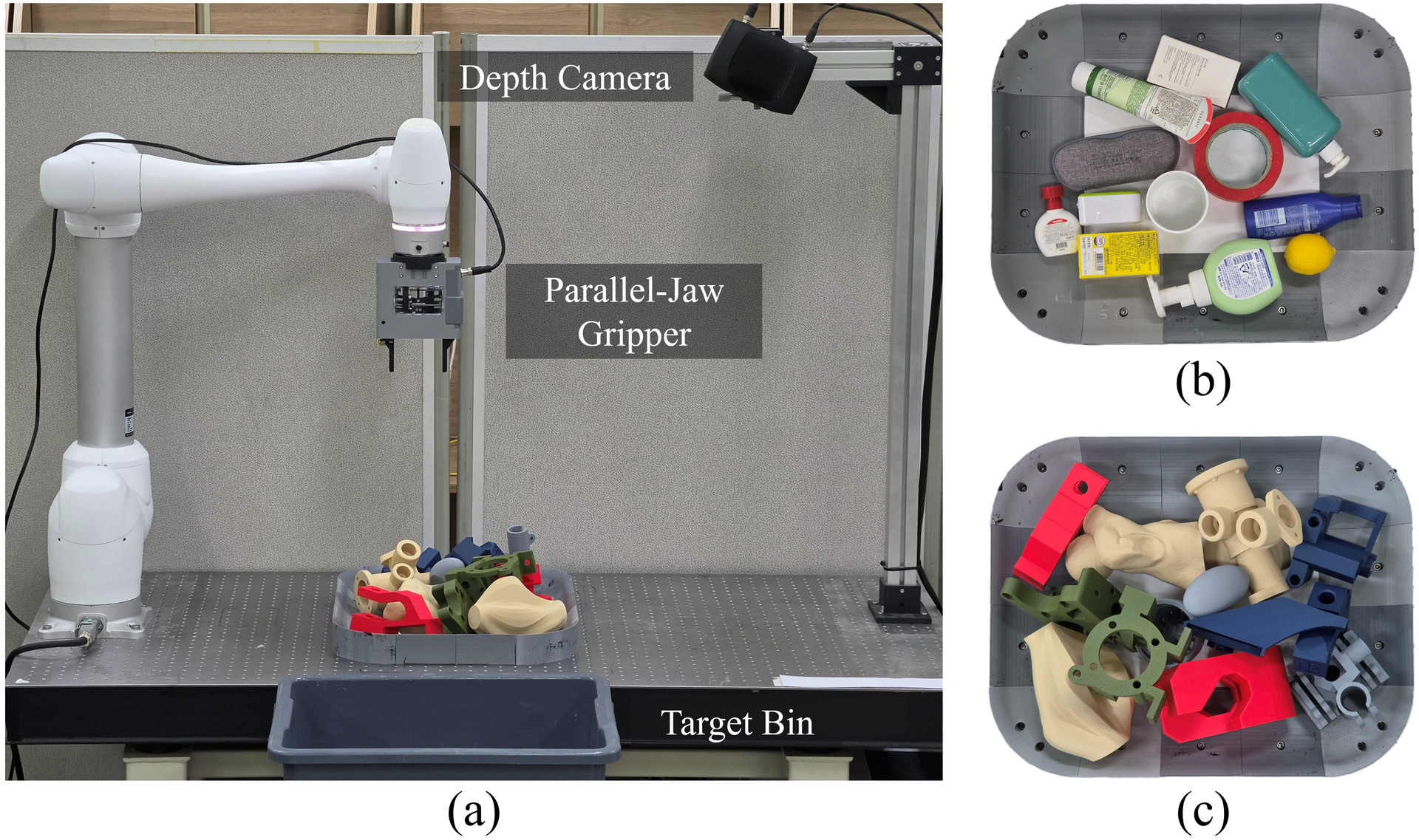
We evaluate the grasping pipeline using a Doosan Robotics M1013 with a custom 80 mm parallel-jaw gripper and a fixed eye-to-hand Zivid Two camera (a). We use two cluttered test sets, each with 12 objects: household objects (b) and 1.6×-scaled Dex-Net adversarial objects (c). All methods use the same CEM-based continuous refinement as in simulation, differing only in the grasp evaluator. Each run starts with 12 objects and terminates after two consecutive failed attempts, with collision-induced emergency stops counted as failures. We perform ten decluttering runs per method and object set.
Results
We report grasp success rate (GSR), declutter rate (DR), and mean picks per hour (MPPH), measured from image acquisition through pick-and-place completion and return to the ready pose. EquiGQNet achieves grasp success comparable to PointNetGPD while attaining the highest MPPH on both object sets. It achieves 95.2% GSR, 100% DR, and 230 MPPH on household objects, and 93.8% GSR, 100% DR, and 206 MPPH on Dex-Net adversarial objects. The GraspGen discriminator shows a larger performance drop than in simulation, particularly on the Dex-Net adversarial objects.
| Evaluation Method | Household Objects | Dex-Net Adversarial | ||||
|---|---|---|---|---|---|---|
| GSR (%) | DR (%) | MPPH | GSR (%) | DR (%) | MPPH | |
| EquiGQNet | 95.2120/126 | 100120/120 | 230 | 93.8120/128 | 100120/120 | 206 |
| PointNetGPD early | 94.8109/115 | 90.8109/120 | 153 | 94.4118/125 | 98.3118/120 | 135 |
| GraspGen Disc. late | 77.184/109 | 70.084/120 | 170 | 66.756/84 | 46.756/120 | 125 |
Decluttering Runs
Representative EquiGQNet decluttering runs are shown below for the household objects (top row) and the 1.6×-scaled Dex-Net adversarial objects (bottom row). All grasps are selected using the same CEM-based continuous refinement pipeline, with EquiGQNet as the grasp evaluator. Videos are shown at 6× speed.
BibTeX
@misc{seo2026equigqnet,
  title        = {EquiGQNet: Fast Grasp Quality Evaluation via Shared Equivariant Point Cloud Encoding},
  author       = {Seo, Sungwon and Won, Jaeseog and Shin, Jiyou and Seo, Youngjin and
                  Kim, Hyunjun and Yoon, Seokmin and Luong, Tuan and Moon, Hyungpil},
  year         = {2026},
  note         = {arXiv preprint, to appear},
  url          = {https://equigqnet.github.io/}
}